
DEFINITION
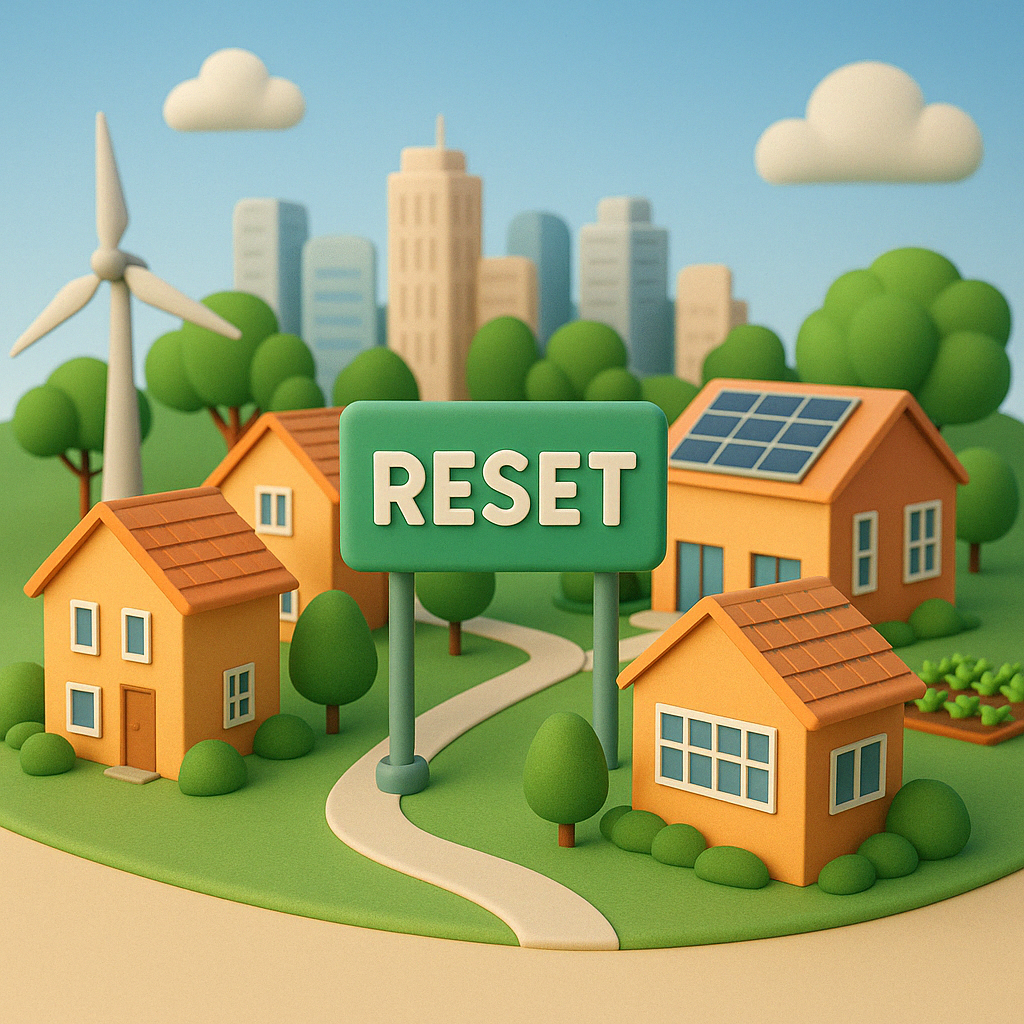
RE:SET Communities are community-led transformation zones, typically organized around 10,000 people, designed to regenerate local economies, restore ecosystems, and strengthen community cohesion. They serve as local engines of planetary change by turning global frameworks like the UN Sustainable Development Goals (SDGs), the Paris Agreement, and the Terra Carta into place-based, people-powered action.
These communities are not external interventions but bottom-up initiatives led by local residents. External partners provide tools, capital, and facilitation only at the invitation and direction of community leadership.
PURPOSE
RE:SET Communities aim to:
- Localize and activate global regenerative goals
- Restore social, ecological, and economic integrity at the community level
- Build circular, inclusive, and sovereign economies from the bottom up
- Empower communities to co-design their future with full ownership of resources and systems
- Serve as living laboratories for systemic transformation and resilience
SYSTEM DESIGN: FIVE-DOMAIN ARCHITECTURE
RE:SET Communities are organized around five domains, supported by ten enterprise service categories. All planning and deployment are community-directed, with technical support as needed.
- Product and Technology Infrastructure
- Deployment of community-prioritized technologies: solar power, water systems, biodigesters, sanitation, modular housing
- Community-run fabrication and repair labs using local knowledge and tools
- Technology choices made through local consultation and systems mapping (e.g., Thortspace)
- Market Enablement and Local Economies
- Cooperative markets, ethical trade, and mutual credit systems
- Barter networks, community currencies, and local value chains
- Micro-enterprise development driven by local innovators and artisans
- Finance and Investment Access
- Community-controlled capital pools, microfunds, and savings groups
- Access to regenerative investment (e.g., via Proodos Capital) on terms set by the community
- Ventures structured as Impact Business Units (IBUs) with transparent returns and community benefit-sharing
- Education and Capacity Building
- Locally developed, SDG-aligned education tailored to culture and language
- Intergenerational learning led by youth, elders, and community educators
- Skills development in regenerative agriculture, storytelling, circular design, digital tools, and governance
- Use of the Social Impact Game (SIG) and participatory planning tools (e.g., Thortspace)
- Governance and Policy Integration
- Community constitutions, restorative councils, and participatory budgeting systems
- Local charters aligned with regenerative principles, not extractive governance
- Representation in national and global policy forums through MIPP Hubs
- Regular feedback loops between community decisions and wider governance systems
CORE PRINCIPLES
- Community-led from inception: residents define vision, governance, and structure
- Place-based wisdom and culture: indigenous and ancestral knowledge integrated into every design choice
- Distributed governance and shared ownership: no central authority, only facilitation
- Intergenerational leadership: children, youth, and elders co-lead all planning and implementation
- Circular systems logic: waste is redefined as value, and systems serve multiple regenerative functions
- Healing-centered infrastructure: peacebuilding, trauma recovery, and relational equity are foundational
- Technology supports, not drives: tools are used only when they serve human, ecological, and cultural wellbeing
RE:SET COMMUNITY MODULES
These modules are adapted to local context, available resources, and cultural priorities:
- RE:SET Lab: local innovation and fabrication center
- RE:SET Market: platform for community trade, circular goods, and bartering
- RE:SET School: intergenerational, multilingual education rooted in the SDGs and community history
- RE:SET Clinic: preventative health services, traditional medicine, and mental wellness support
- RE:SET Stage: cultural commons for storytelling, performance, public dialogue, and expression
- RE:SET Trike: mobile units for education, food delivery, storytelling, and last-mile outreach
- LAIR (Lighthouse Activating Impactful Resources): local intake, verification, and coordination center
- Care Circle: peer-led care network for vulnerable or excluded community members
GLOBAL CONNECTION AND AUTONOMY
RE:SET Communities are fully autonomous but benefit from being connected to a global ecosystem of mutual support:
- GIRMHs (Global Impact Resource Management Hubs) provide access to regenerative capital, resources, and training
- MIPP Hubs offer regional infrastructure for coordination, reporting, and alliance building
- PACIMs (Projects, Assignments, Campaigns, Initiatives, Movements) are launched or joined by communities, aligned with global missions
- Care4Most Profiles document each community’s needs, assets, and aspirations—enabling ethical matchmaking of global resources without dependency
COMMUNITY-DEFINED OUTCOMES
Every RE:SET Community defines its own outcomes, but common targets include:
- Full access to clean water, renewable energy, food, education, health services
- Creation of at least 200 regenerative livelihoods within 24 to 36 months
- Circular economy operating across 80 percent of goods and services by year three
- Full youth literacy in SDG principles, systems thinking, and local stewardship
- Net-positive ecological impact: increased biodiversity, carbon sequestration, soil regeneration
- Peace, conflict transformation, and relational trust as embedded community infrastructure
PARTNERSHIP STRUCTURE
Partners do not lead RE:SET Communities—they respond to them. All engagement is community-permissioned.
Supporting partners include:
- Proodos Capital: investment advisory and regenerative finance structuring
- Learning Without Borders: capacity building, curriculum, and SIG implementation
- Thortspace: participatory design and mapping tool for systems architecture
- Thinkroom and Grindstone Ventures: enterprise growth, mentorship, and venture support
- Youth4Planet: youth storytelling, narrative change, filmmaking
- Catalyst 2030, Global Chamber, and aligned SDG networks: global visibility and solidarity
LOCATIONS AND EXAMPLES
- Stourhead, UK: regenerative heritage and soft power hub, integrating culture, economy, and education
- Bristol, UK: SDG civic activation with Global Goals Centre and Spark Bristol
- Pakistan: community-led youth-driven RE:SET formation under Nilofar Ghardezi
- Sub-Saharan Africa: trike-based agro-regenerative zones supported by Proodos and Thinkroom
- Mobile RE:SETs: adaptable modules for disaster relief, refugee settings, or mobile festival infrastructure
CONCLUSION
RE:SET Communities are the foundation of a new regenerative operating system for the planet—not imposed, but grown. They demonstrate that:
- Communities have the solutions when resourced, respected, and reconnected
- Regeneration is scalable, fundable, measurable, and inclusive
- True transformation must start from the ground up, with those closest to the consequences and solutions
